G’day, Ballarat! When you awoke one July morning to scrape the frost off your windscreen in Wendouree, or shivered the misty afternoon in Buninyong, you must have thought: Is solar even worth it in a Ballarat winter?
It’s a fair dinkum question. We aren’t exactly on the Sunshine Coast. Between the shorter days, the notorious Victorian “grey blanket” of clouds, and temperatures that love to hover near zero, it’s easy to think your solar panels might just be expensive roof decorations for four months of the year.
But here’s the drum: Solar technology in 2026 has changed the game. At Sun 2 Solar, we’re seeing local households wipe out their winter heating spikes by using smarter tech and better local data.
The short answer? Yes. In fact, in some ways, they work better. A common misconception is that solar panels need heat to generate power. They don’t. They need light.
1. Ballarat Cold Climate Efficiency
Solar panels are like most electronics; they hate getting too hot. In the middle of a 40°C Aussie summer, panels can lose efficiency as they overheat. In Ballarat’s crisp, cold winters, your panels operate at a much higher Ballarat cold climate efficiency level. When the sun does peek through on a 5°C day, your panels are performing at their absolute peak electrical potential.
2. Modern Panels vs. The Ballarat Cloud
In 2026, we use N-Type TOPCon and ABC (All Back Contact) cell technology. Unlike older panels that basically gave up the ghost the moment a cloud appeared, these modern modules are designed for “low-light harvest.” They can capture a broader spectrum of light, meaning they’re still chipping away at your power bill even on a gloomy Tuesday in June.
Let’s look at the numbers. It’s a fact that you’ll produce less energy in winter than in summer, usually about 30% to 50% less due to the sun sitting lower in the sky and fewer daylight hours.
While 8kWh might not sound like much compared to a summer peak, remember that in winter, your heat pump hot water system and split systems are working overtime. Every kilowatt you generate is a kilowatt you aren’t buying from the grid at 30+ cents.
If you want to beat the winter blues, you can’t just “set and forget” a standard system. You need a setup tailored for the Central Highlands.
1. Choose Frost-Resistant High-Efficiency Panels
Not all panels are built for a Ballarat frost. We recommend dual-glass (bifacial) panels. Because they have glass on both sides instead of a plastic backsheet, they handle the “freeze-thaw” cycle much better without developing micro-cracks. Plus, bifacial panels can catch light reflecting off frost or light-coloured surfaces, boosting your winter energy output Victoria stats.
2. The “Oversize” Strategy
Costs of panels were considerably reduced in 2026 and cost of batteries and grid power remained high. The cleverest thing Ballarat locals can do is to have oversize your array.
3. Pairing with a Heat Pump
You are missing something in case you are still using gas as a means of hot water. You can store your winter sunshine as hot water by combining your solar with a high-efficiency heat pump. To actually have a thermal battery you simply need to set your timer to be on the day the winter sun is strongest at 12 PM, and you have a free thermal battery.
Many people worry that Ballarat’s weather extends the payback period local data shows for solar. Surprisingly, it’s the opposite. Because Ballarat residents tend to have higher heating requirements (and therefore higher bills), the “avoided cost” of buying electricity is higher.
With the Victoria Solar Homes Program still offering rebates and interest-free loans in 2026, the upfront “sting” is greatly reduced, making the ROI even sweeter.
We don’t just fly in from Melbourne, slap some panels on, and leave. We live here. We know that a north-facing roof in Wendouree needs a different tilt angle to one in Sebastopol to catch that low-slanting winter sun.
Our Winter-Ready Guarantee includes:
Going solar in Ballarat isn’t just a “summer thing.” By choosing frost-resistant high-efficiency panels and sizing your system for the lean months, you can enjoy significant savings year-round. In 2026, the question isn’t whether solar works in winter, it’s how much you’re losing every day you wait to install it.
Ready to crush your winter power bills?
Stop letting the retailers dictate your winter budget. Let the team at Sun 2 Solar design a system that loves the cold as much as a local.
Get Your Free Winter-Optimised Solar Quote – Contact Sun 2 Solar Today!
Does snow affect my solar panels?
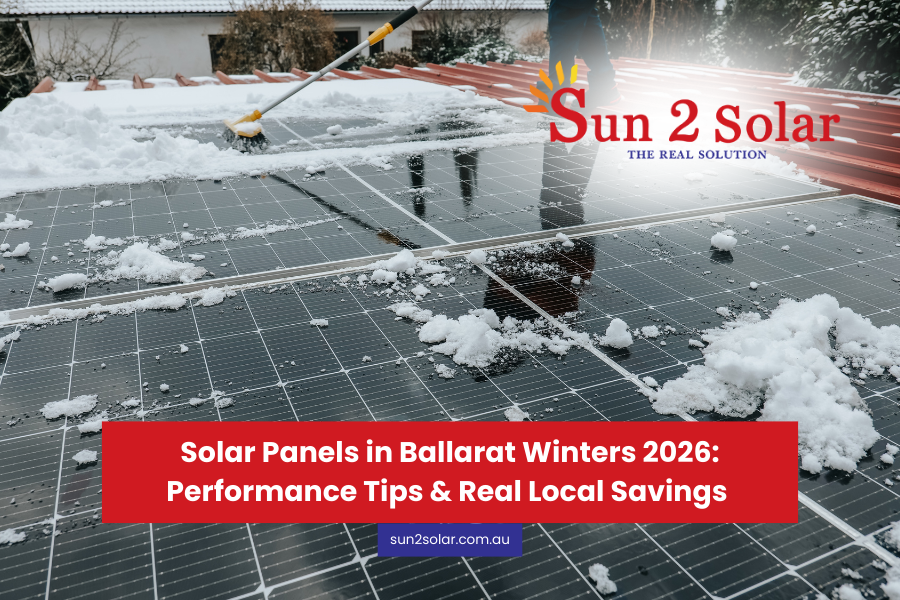
Snow is rare in Ballarat, but it does happen! The good news is that panels are dark and smooth; they usually melt snow quickly, and the “snow wash” leaves your panels cleaner than before, which improves efficiency.
Should I get a battery for winter?
Yes. In winter, you’ll likely use all your solar energy during the day for heating. A battery helps you store any excess from those occasional “bluebird” sunny winter days to get you through the expensive peak evening period.
What is the best angle for solar panels in Ballarat?
For winter performance, a steeper tilt (around 30–40 degrees) is often better to catch the sun while it’s low in the north. We’ll calculate the perfect pitch for your specific roof during our site visit.